
Robots by the Hour: Tutor Raises a $75 Million Series B Led by a16z
Tutor Intelligence announced on November 2 a $75 million Series B led by a16z, with USV and Neo participating, taking total funding to $117 million. The dual-arm semi-humanoid Sonny and the wheeled manipulator Cassie are rented by the hour or by the piece, with no upfront payment and no long-term contract, targeting more than 1,000 robots signed by the end of 2027. The robots are not yet fully autonomous; remote operators still take part in directing them.
- 01THE ROUND — Tutor Intelligence announced the $75 million Series B on November 2, led by a16z with USV and Neo participating, taking total funding to $117 million.
- 02THE CONFIRMATION — Inc.'s November 3 report checked the round, amount, investors, the two robots' division of labor and the end-2027 signing target against the company announcement, and added the website pricing and the remote-operator caveat.
- 03THE WATCHPOINT — Whether Tutor signs more than 1,000 robots by the end of 2027, and whether the remote operator-to-robot ratio falls as models iterate.
WHAT HAPPENEDWhat Happened
Tutor Intelligence announced on November 2 that it has closed a $75 million Series B led by Andreessen Horowitz, with Union Square Ventures and Neo participating, taking total funding to $117 million. USV led the $34 million Series A in December 2025; Neo led the seed round.
The company, spun out of MIT CSAIL in 2021 and headquartered in Watertown, Massachusetts, sells not robots but the work robots do. Customers pay no upfront cost and sign no long-term contract, paying by the hour or by the piece, while Tutor handles deployment, maintenance and software upgrades. Its two robots have clear roles: Sonny, a dual-arm semi-humanoid, does single-item picking; Cassie, a wheeled mobile manipulator, does case picking and palletizing.
Scale figures come from the company announcement: the number of facilities with its robots is nearly four times the level of a year ago, and nearly a third of customers who received robots in the past 12 months are repeat deployments. The company says its target is to sign more than 1,000 robots by the end of 2027, all manufactured and deployed in the United States, serving customers from family businesses to Fortune 50 companies and moving goods from cereal, snacks and candy to cosmetics, home goods and toys.
Pricing comes from the company website as cited by Inc.: $14 to $18 per hour for palletizing and depalletizing scenarios, plus an 80-hour monthly minimum and a $10,000 one-time implementation fee. Inc. also flagged the key caveat: the robots are not yet fully autonomous, and remote operators are still involved in directing them — operators Tutor itself calls "tutors."
The funding backdrop is a historic peak in robotics investment. Citing Crunchbase data, Inc. reported that global robotics startup funding reached $9.9 billion in the third quarter of 2026, more than double the $4.3 billion of a year earlier. The same week, Ultra Robotics raised $62 million for its OP-1 humanoid, as capital concentrates on flexible machines that can do real warehouse work.
WHY IT MATTERSRobotics' commercialization bottleneck is not the machine, but the bill
Tutor's model turns robots from a capital expense into a substitute for labor cost. A plant owner does not need to justify the return on a machine costing hundreds of thousands of dollars, only to compare $14–18 an hour against a temp-labor payroll. That pricing strategy bypasses the hardest gate in robotics: getting the customer to believe first and pay second.
Hourly pricing has a cost, though. The presence of remote operators shows autonomy is not yet a closed loop; labor cost has merely moved from the customer's site to Tutor's operations center. Whether the 1,000-robot signing target is met depends on two ratios: whether the operator-to-robot ratio keeps falling, and whether the repeat rate holds near one third.
WHY IT MATTERSThe data-factory narrative is unfolding on two tracks at once
On the same day, the South Korean government opened a national humanoid data factory while Tutor raised $75 million in the United States to build a commercial one. The consensus on both sides is the same: training data for the physical world does not exist off the shelf and can only be accumulated by real machines doing real jobs in real environments. The difference is who pays — a government budget in Korea, venture capital in the United States.
Tutor's flywheel logic is that every deployment generates training data, the data trains better models, and better models unlock more deployments. The premise of that story is deployment density, and facilities growing nearly fourfold in a year is the only public evidence supporting it. The next verifiable progress will not be in funding news, but in the signing count at the end of 2027.
SIGNAL JUDGMENT — ANALYSISRobots rented by the hour are closer to deployment than robots sold
Tokenta Signal's judgment: the right way to read this news is the business model, not the funding amount. Tutor turns robots into labor that can be procured by the hour, reducing the customer decision from buying equipment to hiring temporary workers — the precondition for warehouse automation to truly scale. The caveats must be kept in view: remote operators are still on the job, the autonomy loop is not yet closed, and 1,000 robots is only a target. Funding proves capital believes in the direction; delivery numbers will prove the model works.
WHAT REMAINS UNCERTAINWhat Remains Uncertain
EVIDENCEEvidence
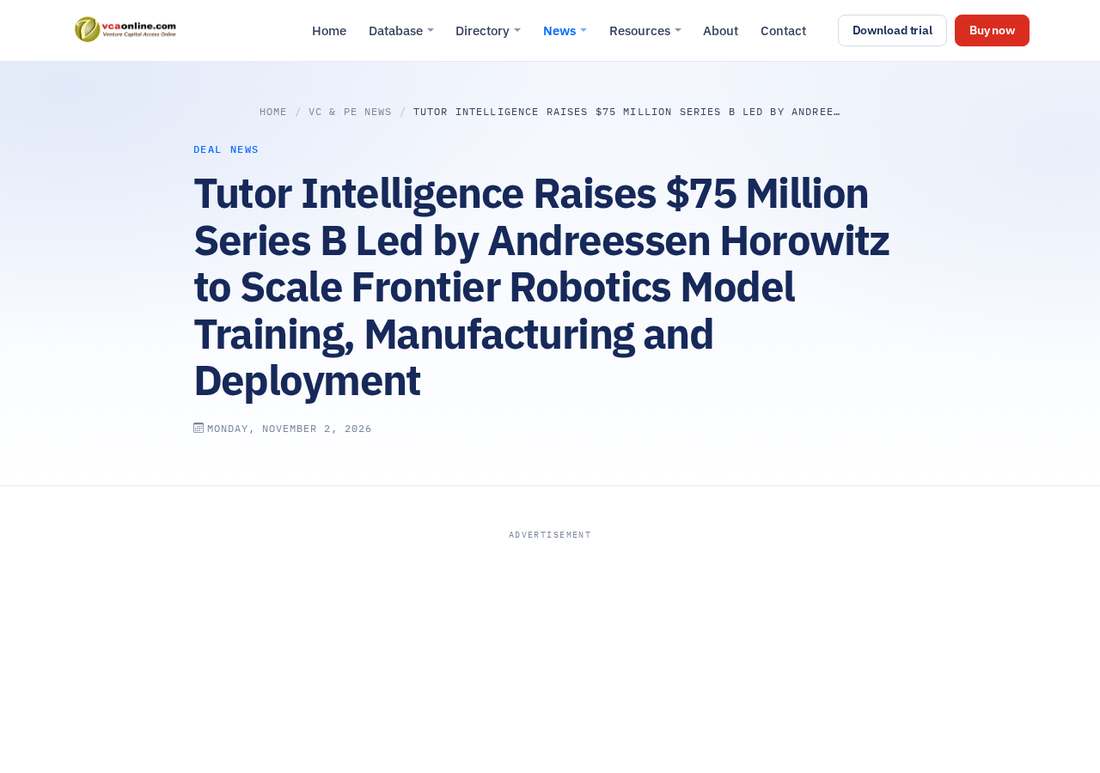
Tutor Intelligence's company announcement page and Inc.'s report page were both opened and verified directly. The $75 million Series B, a16z as lead, USV and Neo participating, $117 million total funding, the Sonny–Cassie division of labor, and the target of more than 1,000 robots signed by the end of 2027 are consistent across both.
PRIMARY SOURCESPrimary Sources
- Tutor Intelligence company announcement
https://www.vcaonline.com/news/2026110201/tutor-intelligence-raises-75-million-series-b-led-by-andreessen-horowitz-to-scale-frontier-robotics-model-training-manufacturing-and-deployment/ - Inc. report
https://www.inc.com/aaron-mok/this-startup-offers-robot-workers-beginning-at-only-14-an-hour-theres-just-1-catch/91429804
RELATEDRelated Intelligence
- Oklo Posts First Revenue of $1.86M as Q3 Loss Widens to $41.7M, Liquidity Hits $3.13B
- Moderna Swings to $162M Profit as Q3 Revenue Hits $1.31B, Crushing Estimates
- Monster Q3 Sales Hit a Record $2.56B on International Growth, but Margins Squeeze Shares
- BILL Q1 Profit Beats, but an Accounting Change Makes Revenue Look Like a Miss