
South Korea opens its first humanoid robot data factory: 12 robots do the work first, and bank the data
South Korea's Ministry of Science and ICT unveiled its first bipedal-humanoid data factory on November 3 at KIMM headquarters in Daejeon. Built by KIMM and ETRI, it runs 12 remotely operated robots collecting task data in its first batch, plans to expand to 25, and will open in phases to companies, universities and research institutes from the end of 2027. The project sits in the K-Moonshot humanoid track, and the government has set aside 2.3 trillion won for the humanoid industry before 2030.
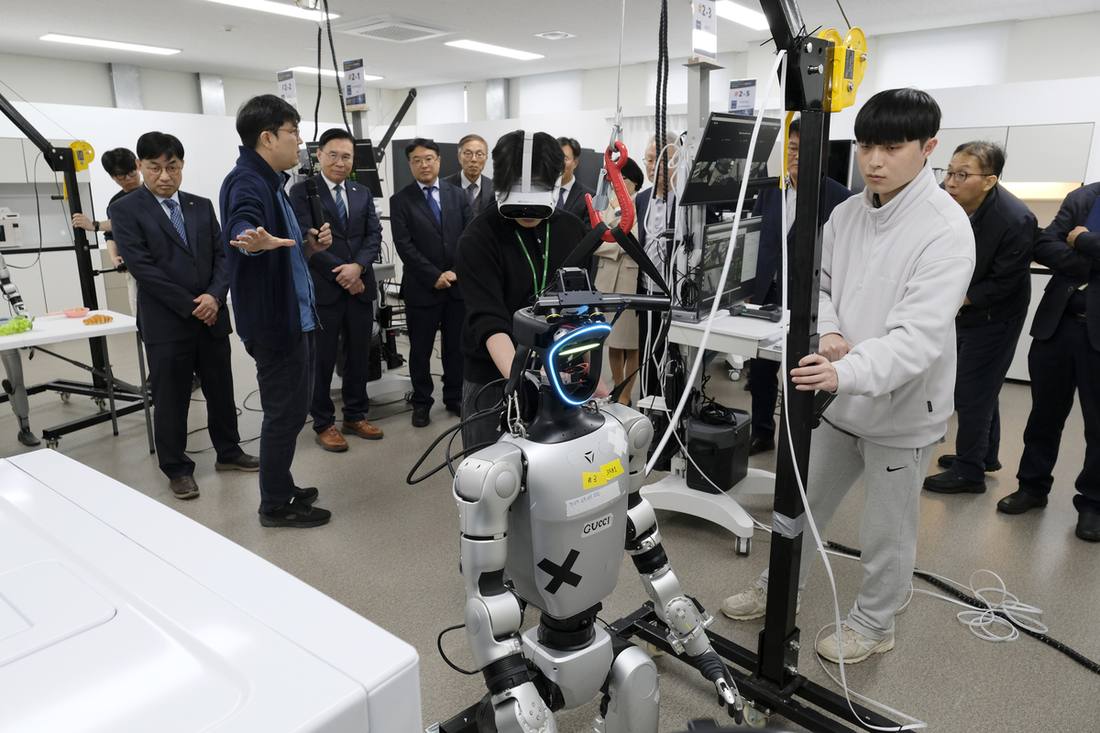
- 01THE OPENING — South Korea's Ministry of Science and ICT unveiled the AI Humanoid Data Factory at KIMM headquarters in Daejeon on November 3, with the first 12 bipedal humanoid robots put to task-data collection.
- 02THE CONFIRMATION — Seoul Economic Daily and Aju Press both reported on November 3, and their accounts of the unveiling time, scale, expansion plan and opening timetable agree.
- 03THE WATCHPOINT — Whether KIMM's own humanoid robot KAIROS 1.0 debuts on schedule in April 2027, and the first outside users and data licence terms when the factory opens in phases at the end of 2027.
WHAT HAPPENEDWhat Happened
South Korea's Ministry of Science and ICT unveiled the AI Humanoid Data Factory on November 3 at the Daejeon headquarters of the Korea Institute of Machinery and Materials (KIMM). Built jointly by KIMM and the Electronics and Telecommunications Research Institute (ETRI), the facility covers about 1,000 square metres over two floors, runs 12 bipedal humanoid robots in its first batch, and plans to expand to 25.
In the unveiling demonstration, researchers remotely operated humanoid robots to fetch items from a refrigerator, handle laundry, tidy a sofa, and work buttons and levers inside a car. Every movement was recorded to train vision-language-action models, the trained models were then loaded back into the robots for testing, and the test data flowed back into training — a closed loop of collection and training.
The project benchmarks itself directly against China. Interact Analysis counts at least 90 humanoid data-collection and training centres in China operating or under construction as of the end of April, at least 64 of them running, and 13 deploying more than 100 robots. In late October, Shanghai announced it had built the world's first heterogeneous humanoid embodied-intelligence training ground in Pudong, having collected more than 50,000 hours of real-robot multimodal data.
The South Korean government has placed the factory in the humanoid track of its K-Moonshot programme. On August 27 the Ministry of Economy and Finance set aside 2.3 trillion won (about $1.7 billion) for the humanoid industry before 2030, including procuring 1,080 domestically made humanoid robots and lifting the localisation rate of core components from about 45% to 80%. Version 1.0 of KIMM's own humanoid robot KAIROS is set to debut in April 2027, and the factory will open in phases to companies, universities and research institutes from the end of 2027.
WHY IT MATTERSThe humanoid race's bottleneck is not the body, but the data
Humanoid hardware is not short of players; what is missing is the data that teaches it to work. Language models have internet text to learn from; the physical world has no ready-made record to copy, so every grasp, door opening and laundry fold must be produced by a real machine in a real environment. Whoever scales collection first, their model learns general tasks first — which is why South Korea classifies the data factory as national infrastructure.
South Korea's play is national-team first: government funding, research institutes building the plant, data circulating inside the system first, then opening to industry from the end of 2027. That pace is slower than China's, where more than 60 centres are already running and single centres with a hundred robots are not rare. South Korea's 12-robot start is more like an entry ticket; the real test comes after expansion to 25 — whether collection speed can catch up, and whether KAIROS can deliver a usable 1.0 in April 2027.
WHY IT MATTERSThe opening timetable matters more than the unveiling
The unveiling is only step one. Who the data belongs to, under what licence, and whether outside teams can get the raw trajectory data — none of this has been published. The official South Korean wording is phased opening of the facility to companies, universities and research institutes, which is a different thing from a public dataset: the former is booking a slot to enter, the latter is download-and-use, and the speed of industry spillover differs by an order of magnitude.
For Chinese readers, the reference value of this story is methodological: when a rival industrialises data collection with a national budget, the news value of single-point model breakthroughs gives way to collection capacity. The next verifiable progress will not come at a press conference but at two 2027 milestones: whether KAIROS 1.0 ships on time, and who the first outside teams into the factory are.
SIGNAL JUDGMENT — ANALYSISThe data factory is the humanoid race's real battlefield
Tokenta Signal's judgment: the right way to read this story is to treat the unveiling as a starting point. Twelve robots and 1,000 square metres are not large; the real information is South Korea's admission that the deciding factor in humanoid intelligence is the industrial-scale production of task data, not a single robot's demonstration. With China's 60-plus running centres as the comparison, South Korea's catch-up clock started on November 3, and the April 2027 KAIROS 1.0 and the year-end opening list are two verifiable tests.
WHAT REMAINS UNCERTAINWhat Remains Uncertain
EVIDENCEEvidence
The Seoul Economic Daily report page and the Aju Press report page were both opened and verified directly; core facts — the unveiling time, the first batch of 12 robots, about 1,000 square metres, expansion to 25, and phased opening from the end of 2027 — agree on both sides.
PRIMARY SOURCESPrimary Sources
- Seoul Economic Daily Report
https://en.sedaily.com/technology/2026/11/03/korea-opens-first-data-factory-to-train-humanoid-robots - Aju Press Report
https://www.ajupress.com//view/20261103143728182
RELATEDRelated Intelligence
- Agility Robotics Debuts on Nasdaq as AGLT, First U.S. Public Pure-Play Humanoid Maker
- Agility Robotics Closes SPAC Deal, Set to Trade on Nasdaq as AGLT on November 5
- Uber Books $59.8 Billion in Q3 and Puts a Number on Autonomy: 700 Driverless Vehicles by Year-End
- Xiaomi's Humanoid Robots Clocked a Full 8-Hour Shift — and Said Nothing About Output