
Google's Strongest Model Goes to Security Teams First, Not the Public
Google released Gemini 4 Carbon on October 28: its strongest model yet, aimed at cybersecurity and long-horizon tasks, ranked first on the Artificial Analysis Intelligence Index with 59 points, but available first only to cybersecurity defenders and trusted partners.
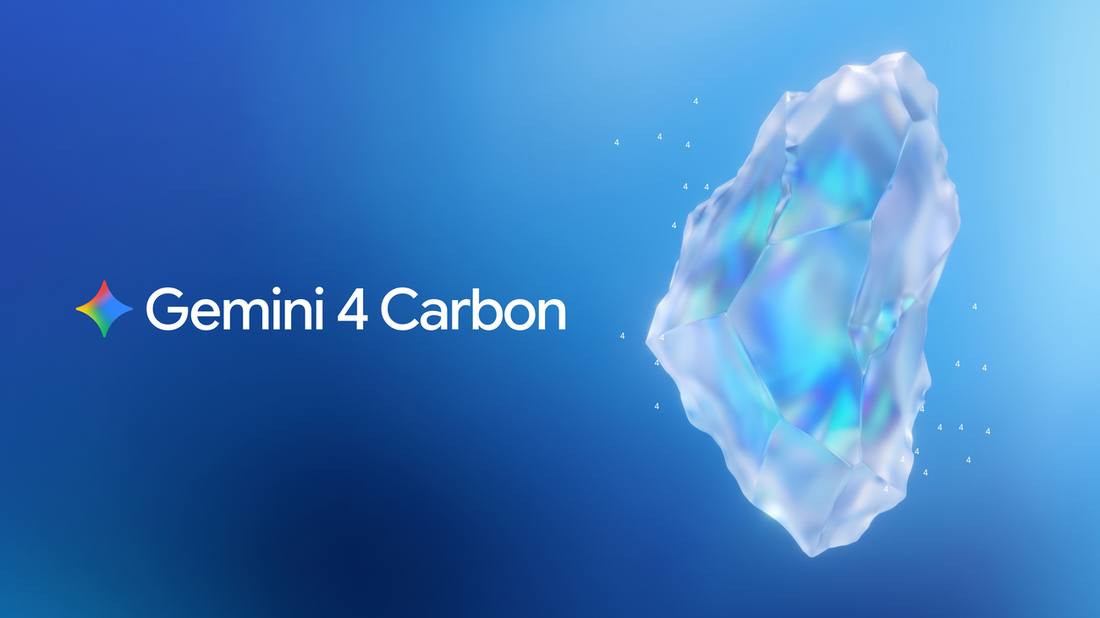
- 01THE LAUNCH — On October 28, Google released Gemini 4 Carbon, just two weeks after Argon.
- 02THE SCORES — Three security benchmarks published: vulnerability discovery, exploit verification and patching all lead the field.
- 03THE GATE — This week it opens to a group of cybersecurity defenders first, then expands via Fairwind.
WHAT HAPPENEDWhat Happened
On October 28, Google released Gemini 4 Carbon, positioned as its strongest model yet, aimed at cybersecurity and long-horizon tasks. Just two weeks after the Gemini 4 Argon release, a second launch within the same generation pushed the frontier cadence to a matter of weeks.
Carbon's security report card is the core of this story: 88.2% on SEC-bench Pro for vulnerability discovery, 54.8% on ExploitGym for verifying exploitability, and 71.0% on CWE-bench for patching. Google also stressed that in the Chrome team's testing, Carbon produced high-quality patches more than 10 times better than a large model from another lab.
The release strategy is equally notable: this week Carbon goes first to a group of cybersecurity defenders, then expands to trusted partners through the Fairwind programme, while also taking part in the U.S. government's voluntary pre-release testing. The strongest model is locked into defenders' hands first, and the public timetable says only "as soon as possible."
THE DEFENSE LOOPSecurity in Three Steps: Find, Verify, Fix, Connected in One Line for the First Time
Carbon's selling point is not a single score but coverage of the whole defence workflow: find the vulnerability, verify whether it can be exploited, patch it to the root cause. Those three steps used to belong to different tools and teams; the model compresses them into one long-horizon task.
For defenders, the real change is in the cost structure: a single scan can produce both a verifiable exploitation path and a mergeable patch, and the security team's bottleneck shifts from "can we find it" to "can we review it."
THE LONG HORIZONLong-Horizon Tasks: Running for Days, Through Dead Ends, to the Root Cause
Google says internal teams have already run Carbon for days on complex multi-step engineering tasks, persisting through dead ends and eventually locating subtle defects across large codebases. Long-horizon capability is no gimmick here; it is a hard requirement of security work, where vulnerabilities rarely appear at step one.
Artificial Analysis's Intelligence Index v5.0 gives Carbon 59 points, ranked first, one point above Claude Opus 5.5's 58. A one-point gap does not signal a generational lead; it signals that the top spot is now changing hands on a weekly cycle.
THE GATED ROLLOUTDefenders First: The Release Sequence Is Itself a Guardrail
Carbon does not go straight on sale: cybersecurity defenders first, then Fairwind trusted partners, and only then developers, enterprises and consumers. Google wrote "who gets it first" into the launch announcement rather than patching it in afterwards.
Staged release is becoming the default posture for frontier models: the closer a capability sits to dual use in attack and defence, the more the release order becomes part of the safety design. Pricing is tiered the same way: an introductory $2 per million input tokens and $10 per million output tokens, against list prices of $4 and $20.
THE SHIFTWhat Changed
SIGNAL JUDGMENT — ANALYSISThe Strongest Model Is Locked Up First; Release Order Has Become Safety Design
Carbon's real signal is not the 59 points but the release order: the strongest capability goes to defenders first. Tokenta Signal's judgment is unchanged: the next round of the frontier race will be about more than scores; it will be about who gets the model first, and in what order.
WHAT REMAINS UNCERTAINWhat Remains Uncertain
EVIDENCEEvidence
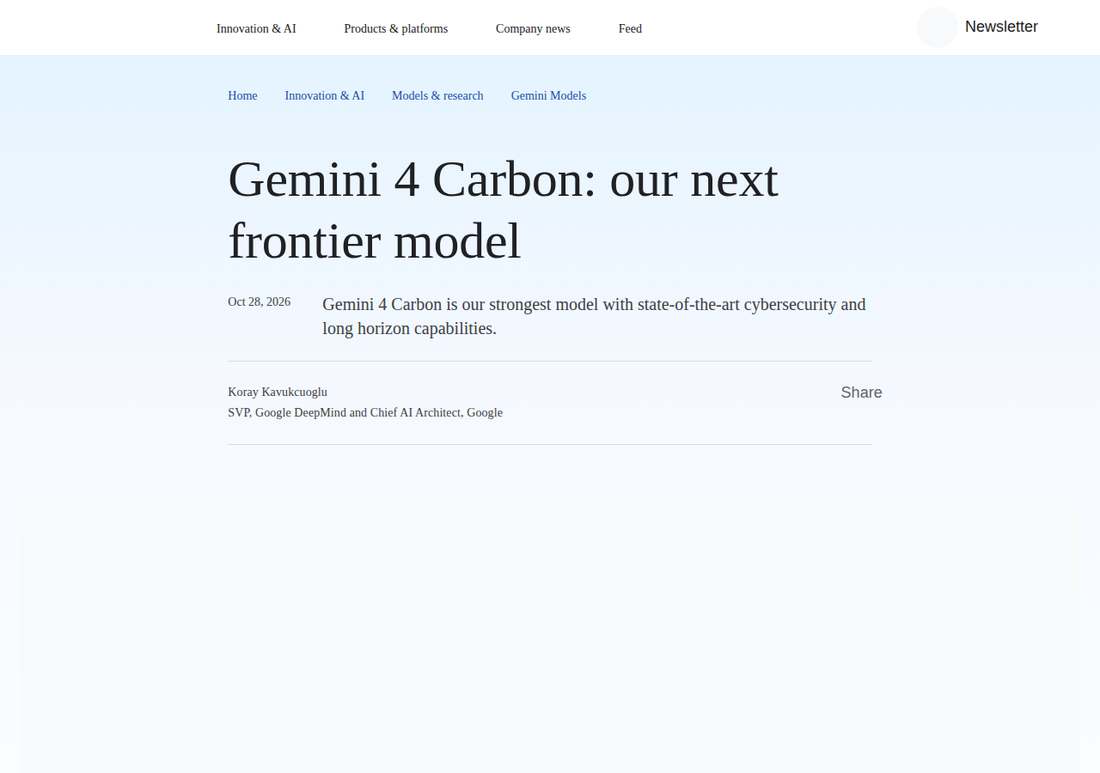
Key points confirmed from the original report: Google announced Gemini 4 Carbon on October 28, positioned as its strongest model for cybersecurity and long-horizon capability; SEC-bench Pro 88.2%, ExploitGym 54.8%, CWE-bench 71.0%; Artificial Analysis Intelligence Index v5.0 score of 59, ranked first; open first to cybersecurity defenders and Fairwind partners, with no public date set.
PRIMARY SOURCESPrimary Sources
- Google official blog: Introducing Gemini 4 Carbon
https://blog.google/innovation-and-ai/models-and-research/gemini-models/introducing-gemini-4-carbon/ - Intelligent Living: Gemini 4 Carbon Takes the AI Crown at Half the Price
https://www.intelligentliving.co/gemini-4-carbon-ai-crown-price/