
DeepMind's Chemistry Agent: Days of Work in About an Hour
Google DeepMind launched Cheminformatics Skills for Antigravity on November 3: an agent that searches thousands of compounds, runs matched-pair analysis, and proposes new rigid macrocycles with synthesis routes, finishing a single iteration in about an hour where it used to take days.
- 01THE CASE — Crizotinib and lorlatinib as a case pair.
- 02THE SEARCH — Thousands of compounds searched within minutes.
- 03THE MODEL — Matched-pair analysis and potency prediction.
WHAT HAPPENEDWhat Happened
Google DeepMind launched Cheminformatics Skills for Antigravity on November 3. The agent searches thousands of compounds, runs matched-pair analysis, and proposes new rigid macrocycles with synthesis routes, finishing in about an hour a single iteration that used to take days.
The demo used lung-cancer drugs crizotinib and lorlatinib as a case pair. Crizotinib has 5 rotatable bonds; cyclized lorlatinib has 0. The agent searched thousands of compounds in minutes, filtered out irrelevant molecules such as buffers and solvents, and cited its sources.
It then completed matched-pair analysis, trained potency-prediction models across multiple architectures and feature sets, with 4 assay readouts and scaffold-split validation, and proposed new rigid macrocycles with several synthesis routes, predicting the potency of each design.
FROM SEARCH TO DESIGNFrom Search to Design
The tooling is built on open-source RDKit, connected to ChEMBL and PubChem. The agent's job is not to query one database, but to string retrieval, filtering, modeling, and design into a single line.
From finding compounds to proposing synthesis routes, a single iteration shrank from days to about an hour. A chemist's waiting time is measured in hours for the first time.
THE LIMIT OF ONE HOURThe Limit of One Hour
DeepMind drew the boundary itself. Computational design is only a verifiable hypothesis, which must be confirmed by synthesis and experiment. Potency prediction is limited by sparse data and experimental noise.
One hour produces a design, not a drug. From design to medicine, the old road of synthesis, testing, and trials still applies. The agent compresses iteration, not validation.
FREE FOR 6 MONTHSThe Free-Six-Months Calculation
10,000 scientists can get Antigravity's highest usage tier free for 6 months, rolled out in batches, subject to eligibility and capacity.
Individual users download the Antigravity app and install the Science plugin; enterprise users connect with a Google Cloud account. What is free is the usage tier, not unlimited use.
THE SHIFTWhat Changed
SIGNAL JUDGMENT — ANALYSISThe Most Expensive Thing Is Waiting
Tokenta Signal's judgment: the real product of Antigravity's chemistry skills is not a molecule, but time. The most expensive thing in drug discovery was never reagents — it was waiting, and DeepMind cut that waiting from days to about an hour.
WHAT REMAINS UNCERTAINWhat Remains Uncertain
EVIDENCEEvidence
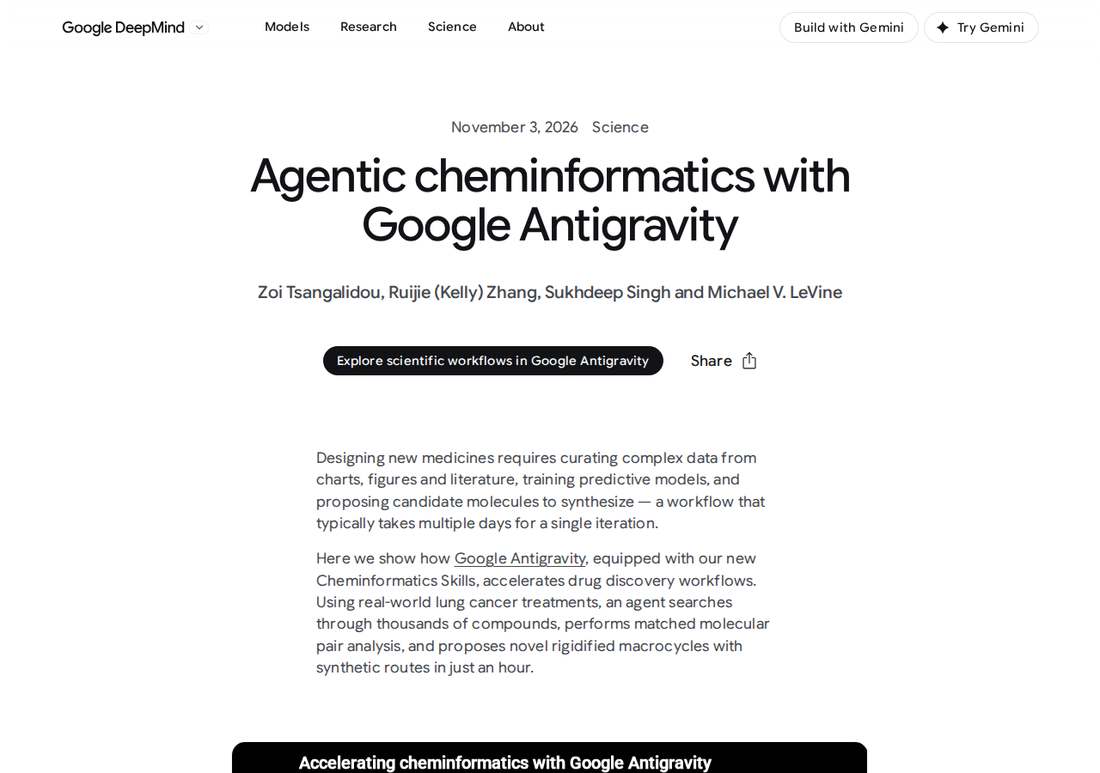
Google DeepMind's blog confirms that Cheminformatics Skills for Antigravity launched on November 3: the agent searches thousands of compounds and proposes new rigid macrocycles with synthesis routes, completing a single iteration in about an hour.
PRIMARY SOURCESPrimary Sources
- Google DeepMind blog: Agentic cheminformatics with Google Antigravity
https://deepmind.google/blog/agentic-cheminformatics-with-google-antigravity/ - DNA Insider: Google DeepMind adds cheminformatics skills to Google Antigravity
https://dnainsider.news/en/signal/google-deepmind-adds-cheminformatics-skills-to-google-antigravity-for-compound-search-and-macrocycle-design-902c0dba