
$13 Billion in Half a Year: China's Robots Fix Their Brains Before Their Moves
Reuters reported on November 2 that Chinese embodied AI companies raised RMB 93.5 billion, about $13 billion, in the first half of 2026 across 322 deals, five times a year earlier, with funding flowing to robot intelligence developers rather than only complete-machine makers.
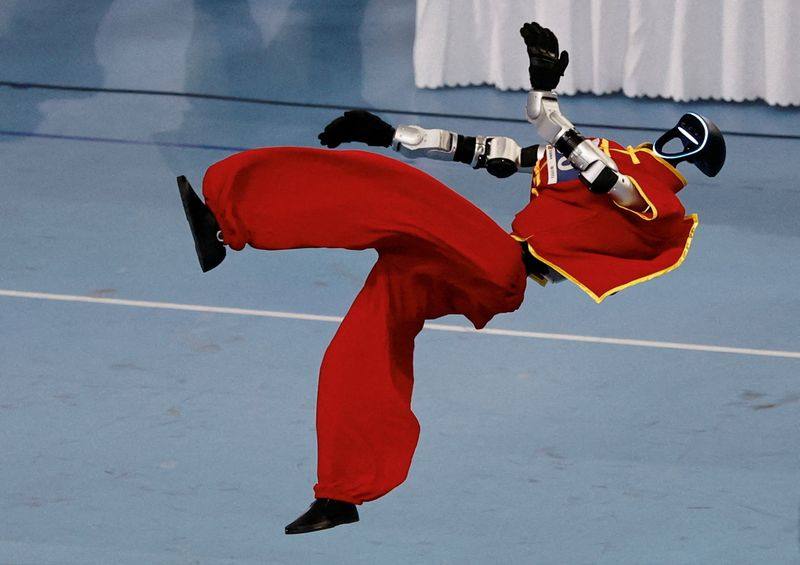
- 01THE MOVES — Chinese makers have already built humanoid robots that run and dance.
- 02THE SHIFT — Reuters reported on November 2 that the industry focus is shifting to robot intelligence.
- 03THE MONEY — First-half funding of RMB 93.5 billion across 322 deals, five times a year earlier.
WHAT HAPPENEDWhat Happened
Reuters reported from Beijing on November 2 that China's robotics companies are shifting their focus from movement to brains. In recent years these companies built humanoid robots that can run, dance and do backflips; now they must solve the software that lets robots generalize to unfamiliar tasks.
The money has already moved first. Data from ITjuzi show Chinese embodied AI companies raised RMB 93.5 billion, about $13 billion, in the first half of 2026, across 322 deals, five times the same period a year earlier. Funding is flowing increasingly to specialist developers of robot intelligence, not only to complete-machine makers.
Reuters interviewed founders and executives at five Chinese robotics companies. The consensus is that hardware demonstrations have proven the machines can move; the real threshold is understanding environments, learning unfamiliar tasks and adapting to new work without being programmed item by item.
MOVES DONE, BRAINS NEXTAfter Movement Comes Work
Running, jumping and somersaults are demonstrations; work is a product. A demonstration only needs the movements choreographed; work requires judgment in environments never seen before. One is a choreography problem, the other a generalization problem, and the difficulty is not of the same order.
Chinese makers built the movement first and are adding the brains after, for practical reasons. The hardware supply chain and manufacturing capacity already exist, while the intelligence layer needs time and data. Money now flooding into the intelligence layer shows the industry itself knows where its short board is.
MONEY FOLLOWS SOFTWAREFivefold Growth, and the Money Is Buying Software, Not Machines
The most instructive part of the RMB 93.5 billion figure is not the total but the structure. Funding is flowing increasingly to specialist developers of robot intelligence, which shows investors are no longer satisfied with backing yet another company whose robots can walk.
Complete-machine companies and intelligence companies are dividing the labor. The former keep driving hardware costs down; the latter focus on making the same machine adapt to more tasks. The finer the division of labor, the more the ecosystem resembles today's phone industry, with its own leaders in hardware and software alike.
THE GENERALIZATION TESTGeneral Tasks Are Embodied AI's Real Examination
The promise of embodied AI has always been that one machine can learn tasks it was never programmed for item by item. Until that promise is delivered, every funding figure is only an entry ticket.
Reuters' report gives no timetable for delivery, and the judgment of the five interviewed companies is only a directional consensus. The next round of embodied AI news should not be another funding total, but a machine that worked in a real setting for a month straight without incident.
THE SHIFTWhat Changed
SIGNAL JUDGMENT — ANALYSISRobots Fix Their Brains Before Their Moves
Tokenta Signal's judgment: the embodied AI race is changing tracks. The dividend from movement demonstrations is spent; the next stage is about whose machines can learn to work on unfamiliar tasks by themselves.
WHAT REMAINS UNCERTAINWhat Remains Uncertain
EVIDENCEEvidence
The original confirms Reuters' November 2 report that Chinese embodied AI companies raised RMB 93.5 billion, about $13 billion, in the first half of 2026 across 322 deals, five times a year earlier, with funding flowing to robot intelligence developers.
PRIMARY SOURCESPrimary Sources
- Reuters via WNCY: China's robot makers have mastered the moves. Now comes the race for brains
https://wncy.com/2026/11/01/chinas-robot-makers-have-mastered-the-moves-now-comes-the-race-for-brains/ - Tech Current: Tech Current Daily Brief, November 02, 2026
https://teccurrent.com/articles/daily-brief-2026-11-02/
RELATEDRelated Intelligence
- Agility Robotics Debuts on Nasdaq as AGLT, First U.S. Public Pure-Play Humanoid Maker
- Agility Robotics Closes SPAC Deal, Set to Trade on Nasdaq as AGLT on November 5
- Uber Books $59.8 Billion in Q3 and Puts a Number on Autonomy: 700 Driverless Vehicles by Year-End
- South Korea opens its first humanoid robot data factory: 12 robots do the work first, and bank the data