
OpenAI claims its search volume has reached one-fifth of Google's: the methodology is its own, so do not take the share at face value
Adam Fry, OpenAI's head of consumer products, told Big Technology on November 2 that the volume of ChatGPT questions triggering web search is roughly one-fifth of Google's query volume, counted per question that triggers a web search. OpenAI has not disclosed absolute figures or its method for estimating Google's volume; third-party modelling estimates range from 7.5% to 12%. Over the same period, ChatGPT's weekly users rose from 1 billion to 1.2 billion in 60 days.
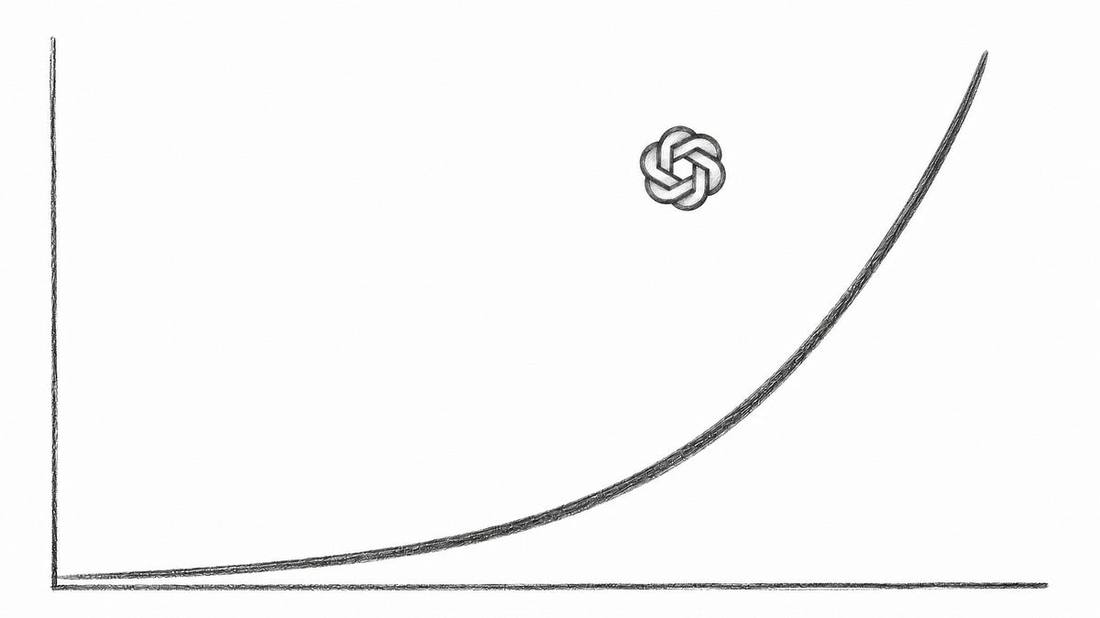
- 01THE DISCLOSURE — OpenAI executive Fry disclosed at the November 2 dinner to Big Technology that ChatGPT's search-like volume is roughly one-fifth of Google's.
- 02THE CONFIRMATION — AIStockWire's independent report of November 3 checked the core quotations, counting methodology and user-growth figures and found them consistent.
- 03THE WATCHPOINT — Whether OpenAI provides absolute search volumes and its Google-volume estimation method in later earnings or official disclosures, and the launch timing of the Chat and Work merger.
WHAT HAPPENEDWhat Happened
Adam Fry, OpenAI's head of consumer products, told Big Technology's Alex Kantrowitz at an OpenAI dinner in New York on November 2 that ChatGPT's search-like query volume is now about one-fifth of Google's query volume. Fry's counting method: each time a user asks a question that triggers a ChatGPT web search counts as one search, covering lookups of people, places and things, and finance and health questions requiring the latest information.
Fry gave no absolute search figures and did not explain how OpenAI estimates Google's volume. Asked whether this means ChatGPT is already several times Bing, which holds about 5% share, Fry did not answer directly and turned instead to user growth: ChatGPT rose from 1 billion weekly active users to 1.2 billion in 60 days.
In the same interview Fry disclosed several other figures: voice features have 250 million weekly users; users generate 1.5 billion images a week with ChatGPT; advertising annualised revenue passed $1 billion within 200 days (a milestone OpenAI had already announced in August); and the Chat and Work modes are planned to merge, with timing described only as coming soon.
The countervailing numbers are also public: Alphabet said on October 29 that Google Search is growing at its fastest year-on-year rate in five years. Third-party modelling estimates diverge sharply — seoClarity estimated in October that ChatGPT's search-like activity is about 7.5% of Google's query volume, and Ahrefs estimated about 12% in February. Different methodologies, different answers.
WHY IT MATTERSThe value of 'one-fifth' lies in the methodology, not the ranking
Fry's claim is easily read as market share, but it is not. OpenAI compares the number of its own questions that trigger web search with Google's query count, and the two counting methods are not symmetric: one Google query is one search, while a single ChatGPT conversation can trigger web search multiple times, and pure conversation or pure reasoning questions never enter the count at all.
More importantly, the denominator is undisclosed. With no method for estimating Google's volume and no absolute numbers, the one-fifth cannot be independently recomputed. It reads more like a positioning signal released by a company at a dinner than an auditable share report, and should be treated as a company claim, not third-party share data.
WHY IT MATTERSThe real news is user growth, not the search comparison
Two hundred million new weekly active users in 60 days is harder than the one-fifth analogy. That figure has clear start and end points and a comparable prior value, and it shows ChatGPT's growth curve has not flattened. At the same time Google Search is still growing at its fastest pace in five years, so the replacement narrative does not hold: the pie is getting bigger, and both sides are eating.
For ordinary users, the contest's landing point is not whose query volume is larger but the entry habit: more and more questions no longer begin in a search box but in a conversation. The Chat and Work merger Fry mentioned is precisely about pushing that habit from questions to getting things done.
SIGNAL JUDGMENT — ANALYSISDo not read a company claim as market share
Tokenta Signal's judgment: this story should be read in layers. The user-growth layer is hard numbers and worth recording. The one-fifth layer is a positioning statement on OpenAI's own methodology — worth hearing, but not to be taken as share. The search market has not been overturned, Google is still accelerating, and the conversational entry point is siphoning off questions: those three sentences are all true at once.
WHAT REMAINS UNCERTAINWhat Remains Uncertain
EVIDENCEEvidence
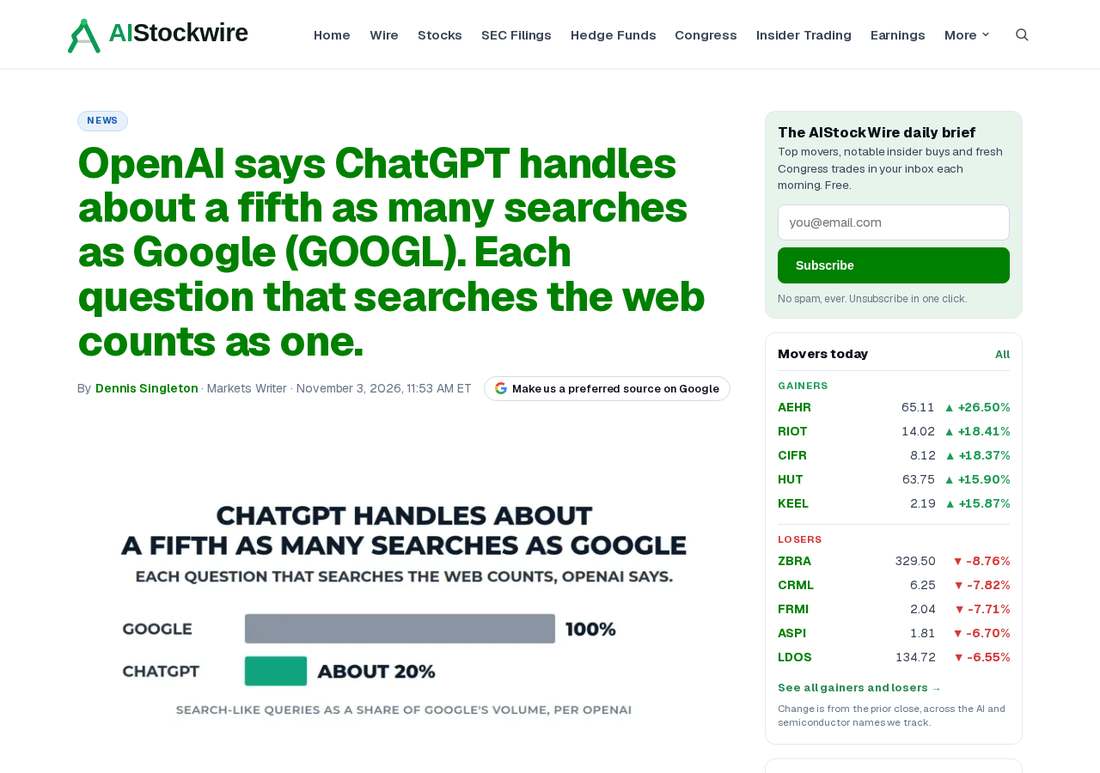
Confirmed by two sources, Big Technology's original interview report and AIStockWire's independent report; the AIStockWire report page was opened and verified, and the interview's core quotations and counting methodology agree on both sides.
PRIMARY SOURCESPrimary Sources
- Big Technology Interview Report
https://www.bigtechnology.com/p/openai-chatgpt-search-is-about-20 - AIStockWire Independent Report
https://aistockwire.com/blog/openai-chatgpt-search-one-fifth-google-googl-what-counts-november-2026
RELATEDRelated Intelligence
- Microsoft Winds Down Its Oracle AI Cloud Rental as Older Nvidia Chips Fall Behind
- An Unreleased Anthropic Model Proved an 18-Year-Old Quantum Conjecture, Machine-Checked in Lean
- IBM Unveils Quantum System Two in Chicago, Its Most Advanced Computer Yet, Powered by Nighthawk
- Vistra Posts $1.14B Q3 Profit as Power EBITDA Jumps Over 50%, Lifts 2026 Outlook