
Enterprise AI spending quintupled in a year — and the buyer is no longer human, but agents
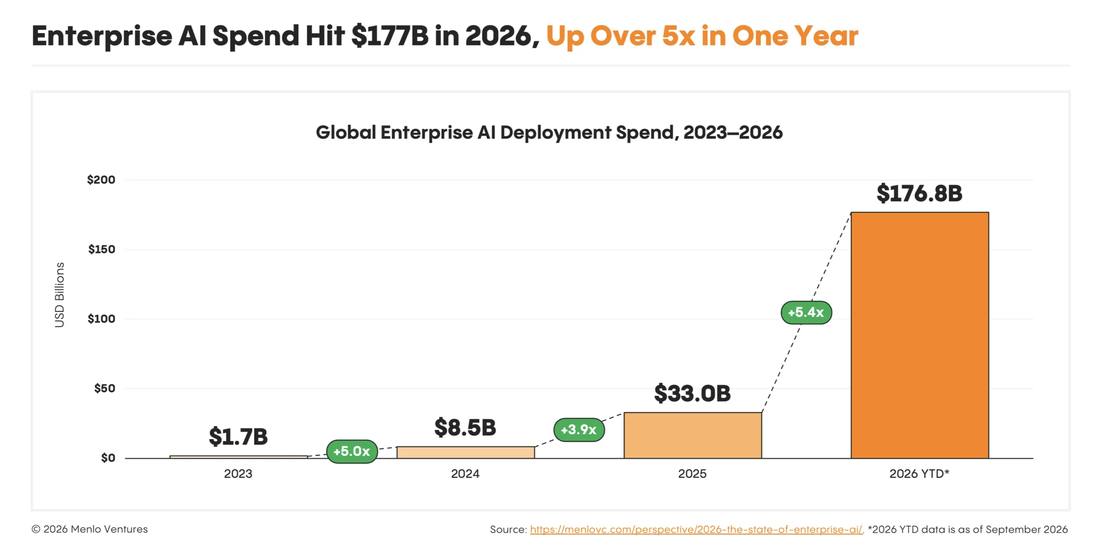
Menlo Ventures released its State of Enterprise AI report on November 3, 2026: enterprise AI deployment spending reached $176.8 billion, up 5.4 times year on year; agents account for 80% of OpenRouter token volume; and Anthropic, OpenAI and Google together take 69% of deployment spending.
- 01THE RELEASE — Menlo Ventures released its 2026 State of Enterprise AI report on November 3, 2026, with enterprise AI deployment spending reaching $176.8 billion.
- 02THE CONFIRMATION — The official press release and the report page confirmed on the same day the three core data sets: spending, agents' token share, and vendor shares.
- 03THE WATCHPOINT — The durability of over-budget spending, and share movements after the next generation of models is released.
WHAT HAPPENEDWhat Happened
Menlo Ventures released its fourth annual State of Enterprise AI report on November 3, 2026: as of September 2026, enterprise AI deployment spending had reached $176.8 billion, up 5.4 times from $33 billion in 2025, with growth accelerating further from the prior year's 3.9 times.
By the report's methodology, the share of companies paying for AI rose only from 55% to 65%; growth came mainly from existing buyers spending more, not from an influx of new buyers. Enterprise budgets at the start of the year were already close to twice 2025's spending, and actual spending still came in at 2.5 times budget.
Agents have become the models' largest consumers: OpenRouter data shows agents generate 80% of the platform's token volume, roughly seven times human usage. Agent traffic has grown 37 times since passing human traffic in February 2026, while human usage grew five times over the same period.
Spending is highly concentrated: Anthropic, OpenAI and Google together account for 69% of enterprise AI deployment spending, up from 50% in 2025. In enterprise large-model API spending, Anthropic's share rose from 40% to 55%, OpenAI's from 27% to 31%, and Google's fell from 21% to 9%.
The application layer has become the growth engine: enterprise AI application spending was about $77 billion, up from $19 billion the year before, of which coding accounted for $34 billion and assistants and productivity tools $25 billion — together 76% of application spending. Healthcare remains the largest vertical market, at about $3.7 billion.
The report offers one conversion for measuring returns: for every $1 spent on model training, enterprises spend $1.70 putting AI to work. Of new spending, 55% came from new budgets and 22% from existing software budgets, and most of it still flowed to incumbent vendors' AI-enabled products.
WHY IT MATTERSThe spending curve has decoupled from the buyer count
Spending growth of 5.4 times, against a rise of just 10 percentage points in the share of paying companies over the same period, shows this round of growth is not market expansion but existing buyers doubling down in the same direction. With actual spending outrunning budgets two years running, enterprise AI budgeting processes can no longer keep up with the climb in usage.
For vendors, this matters more than new-customer counts: revenue is coming from existing customers' usage expansion, and the rhythm of renewals and upsells will decide next year's curve more than customer acquisition will.
WHY IT MATTERSThe consuming subject has changed places
Agents taking 80% of token volume on OpenRouter marks the subject of model consumption shifting from humans to machines. The objects of latency, reliability and cost control shift with it: what was optimised before was a person's waiting experience; what is optimised now is the throughput and the bill of thousands of parallel tasks.
The share reshuffle is just as violent: Anthropic and OpenAI together take 86% of enterprise API spending, while Google fell from 21% to 9% within a year. Every major model release can reorder the seats; no one's position is locked in.
SIGNAL JUDGMENT — ANALYSISGrowth is coming from existing buyers spending more, not new buyers arriving
Tokenta Signal's judgment: the real signal in this report is not the $177 billion headline but the growth structure — the share of paying companies moved only 10 percentage points while spending rose more than fivefold. The main engine of AI spending has shifted from trial purchases to expansion by the installed base. The next signal is the durability of this over-budget spending, and whether Google's share losses stop after the next model generation.
WHAT REMAINS UNCERTAINWhat Remains Uncertain
EVIDENCEEvidence
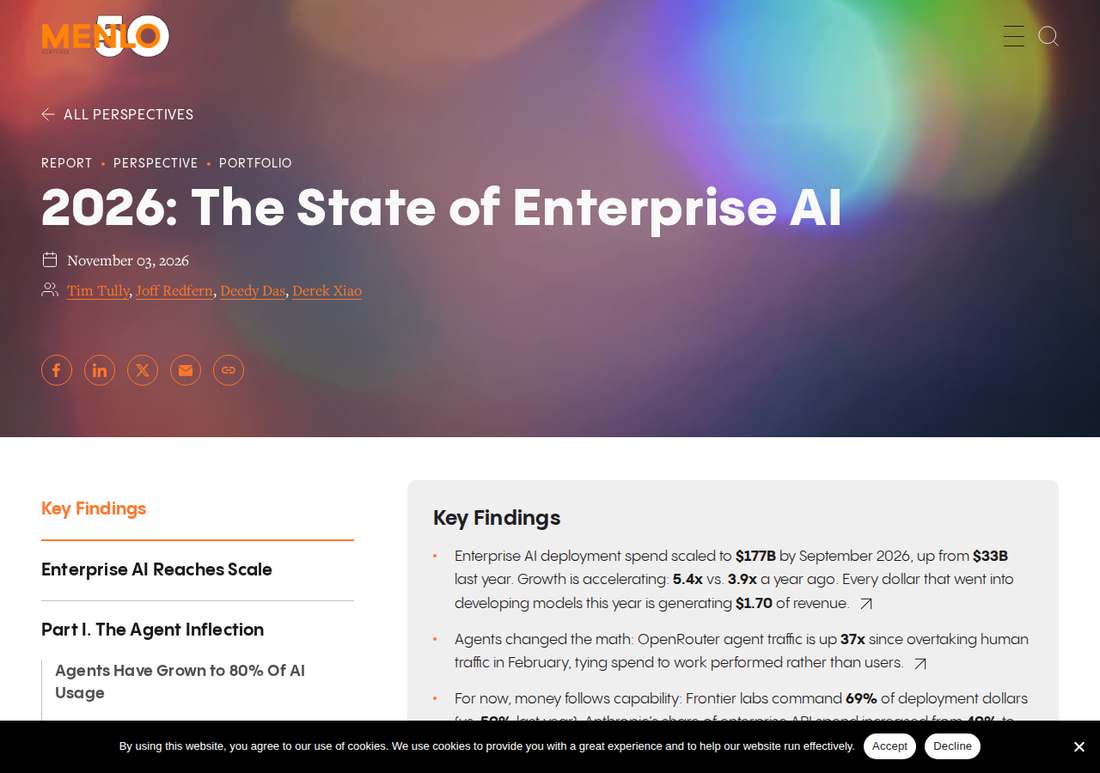
Confirmed by two sources, Menlo Ventures' official press release and its report page; the original links were opened and verified.
PRIMARY SOURCESPrimary Sources
- Menlo Ventures Official Press Release
https://www.globenewswire.com/news-release/2026/11/03/3394279/0/en/menlo-ventures-2026-state-of-enterprise-ai-report-enterprise-ai-spending-hits-177b-up-5-4x-in-one-year-as-agents-take-over.html - Menlo Ventures Report Page
https://menlovc.com/perspective/2026-the-state-of-enterprise-ai/
RELATEDRelated Intelligence
- Microsoft Winds Down Its Oracle AI Cloud Rental as Older Nvidia Chips Fall Behind
- An Unreleased Anthropic Model Proved an 18-Year-Old Quantum Conjecture, Machine-Checked in Lean
- IBM Unveils Quantum System Two in Chicago, Its Most Advanced Computer Yet, Powered by Nighthawk
- Vistra Posts $1.14B Q3 Profit as Power EBITDA Jumps Over 50%, Lifts 2026 Outlook