
Six 2-Billion-Parameter Models, Squeezed Into a Phone
On October 27, Liquid AI released LFM3: all six models derive from the LFM3-1.7B base, the text model was pretrained on 22 trillion tokens, context is 256K, and it takes up about 1GB at 4-bit precision.
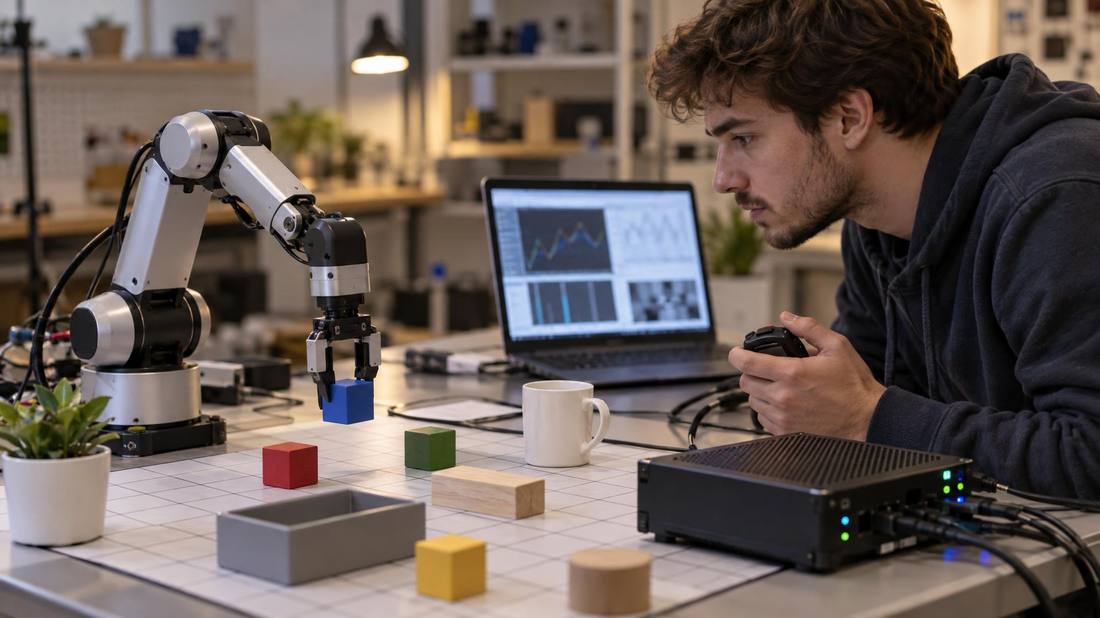
- 01THE LAUNCH — On October 27, Liquid AI released the six-model LFM3 family.
- 02THE BACKBONE — All derive from a 1.7-billion-parameter base pretrained on 22 trillion tokens.
- 03THE TARGET — Phones, laptops, cars and single-GPU local deployment.
WHAT HAPPENEDWhat Happened
On October 27, Liquid AI released the LFM3 family: six open-weight models of about 2 billion parameters, covering text, vision-language, audio, full-modal and two decision models, all derived from a single 1.7-billion-parameter base. The text model was pretrained on 22 trillion tokens, with a context window of 256K.
The architecture is a triple-hybrid design combining gated short convolutions, sliding-window attention and global attention. The company says the text model outscored the five-times-larger Qwen3.5-9B on average across its own 29 benchmarks, and that the vision model's average across 62 vision benchmarks is comparable to models six times its size. All benchmark figures are self-reported by the vendor.
The deployment targets are concrete: phones, laptops, cars and single-GPU local deployment, with launch partners including Ambarella, AMD, Arm, Nvidia and Qualcomm. On licensing, companies with annual revenue under $10 million can use the models commercially for free; above that threshold, a separate commercial license is required.
ONE BACKBONE, SIX BODIESOne Backbone, Six Bodies
Six models sharing one backbone spreads research and development costs across six products. Deployers pick a model by task instead of building a separate stack for each modality.
The decision models are the most distinctive type: instead of generating long replies, they return calibrated answers directly, aimed at bounded tasks such as ticketing and document Q&A.
THE MODEL CARD WARNINGSmall Models' Limits, Written by the Vendor Into the Card
The LFM3 text model's model card states plainly that it is not recommended for agentic programming or complex multi-step reasoning. However bright the vendor's benchmark results, the scope of use must be read from the card.
The correct use of small models is bounded tasks: browser automation, multimodal routing, voice interfaces, extraction and decision routing.
THE LICENSE LINEThe Free Commercial Threshold Hides in the License
Companies with annual revenue under $10 million can use the models commercially for free; above the threshold, a commercial license is required. Downloading the weights for free does not mean all commercial use is free.
When evaluating small models, license terms matter as much as benchmark scores: the former decides cost, the latter capability.
THE SHIFTWhat Changed
SIGNAL JUDGMENT — ANALYSISSmall Models Delivered as a Set Are the Real Starting Point for Local AI
Tokenta Signal's judgment is unchanged: LFM3's significance is not the parameter count, but that it packages multimodal capability into a set that can be selected by task locally, with the boundaries written into the model card.
WHAT REMAINS UNCERTAINWhat Remains Uncertain
EVIDENCEEvidence
Key points confirmed from the original report: on October 27, Liquid AI released LFM3, six models of about 2 billion parameters sharing a 1.7-billion-parameter base; the text model was pretrained on 22 trillion tokens with 256K context; vendor-reported benchmarks beat larger models; commercial use is free below $10 million in annual revenue.
PRIMARY SOURCESPrimary Sources
- Unite.AI: Liquid AI Launches LFM3 Family of Six Open-Weight 2B-Class Models
https://www.unite.ai/liquid-ai-launches-lfm3-family-of-six-open-weight-2b-class-models/ - CryptoBriefing: Liquid AI unveils LFM3 family of customizable AI models for local deployment
https://cryptobriefing.com/liquid-ai-lfm3-local-ai-models/
RELATEDRelated Intelligence
- Microsoft Winds Down Its Oracle AI Cloud Rental as Older Nvidia Chips Fall Behind
- An Unreleased Anthropic Model Proved an 18-Year-Old Quantum Conjecture, Machine-Checked in Lean
- IBM Unveils Quantum System Two in Chicago, Its Most Advanced Computer Yet, Powered by Nighthawk
- Vistra Posts $1.14B Q3 Profit as Power EBITDA Jumps Over 50%, Lifts 2026 Outlook