
India puts three home-grown models on the shelf at once: EKA-1 and Dhīr lead with offline deployment as sovereign models go on sale
India released three home-grown foundation models on November 3, 2026: Soket Labs' EKA-1 (about 26 billion parameters, trained on 7.5 trillion tokens) and ZenteiQ's Dhīr 2B (2.03B, dense) and Dhīr 5B (5.09B, mixture-of-experts), all deployable offline, with Dhīr weights to be opened via AIKosh under Apache 2.0.
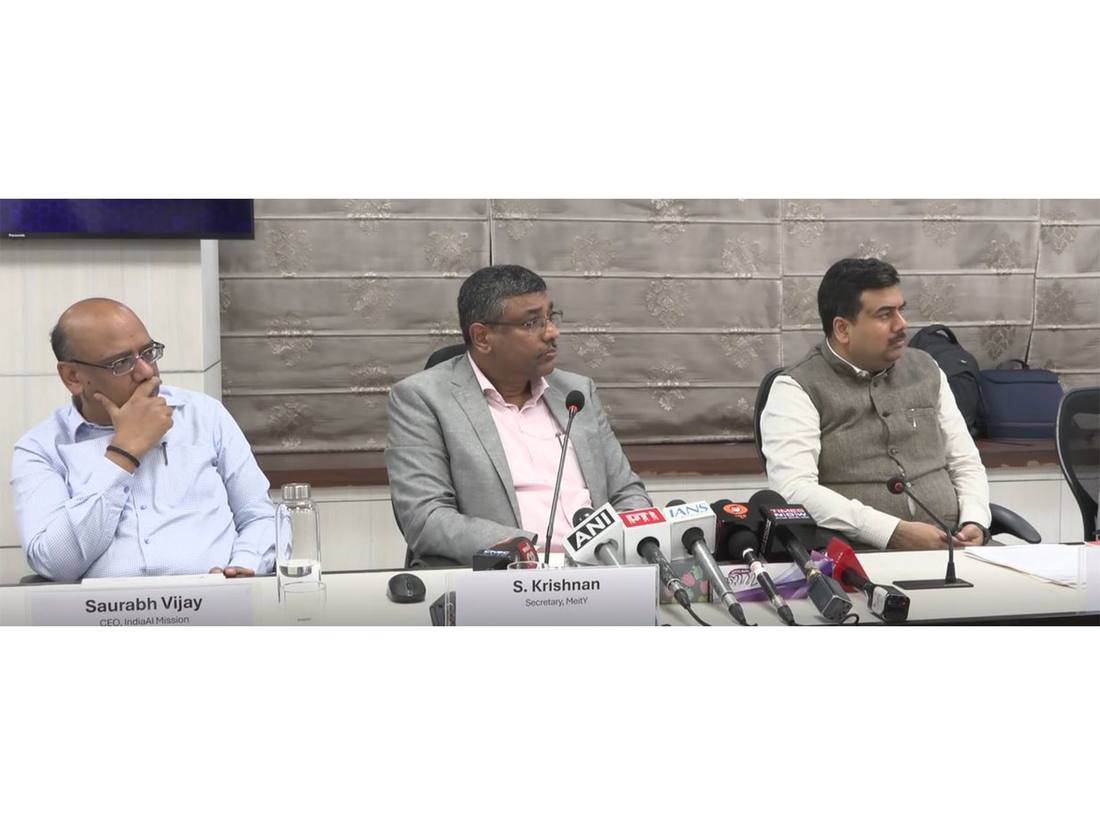
- 01THE ANNOUNCEMENT — MeitY unveiled EKA-1, Dhīr 2B and Dhīr 5B in New Delhi on November 3, 2026 — the first public output of the IndiaAI Mission foundation-model programme.
- 02THE CONFIRMATION — The ANI release and Elets CIO's report cross-check: the releasing bodies, the three models and the offline-deployment claims agree, with architecture details following the company's account.
- 03THE WATCHPOINT — Whether the weights and evaluation tools on AIKosh are genuinely usable, whether Dhīr 9B and Soket's 120-billion-parameter model ship on schedule, and whether any real enterprise deployments follow.
WHAT HAPPENEDWhat Happened
On November 3, 2026, India's Ministry of Electronics and Information Technology (MeitY) unveiled three home-grown foundation models in New Delhi: Soket Labs' EKA-1 and ZenteiQ's Dhīr 2B and Dhīr 5B, all results of the IndiaAI Mission foundation-model programme, unveiled by MeitY Secretary S. Krishnan.
EKA-1 is a foundation model of about 26 billion parameters, trained on roughly 7.5 trillion tokens, aimed at mathematics, coding and reasoning, supporting more than 100 Indian and international languages as well as programming languages, and deployable on-premises, in private clouds and in disconnected environments.
Dhīr 2B is a dense model with 2.03B parameters; Dhīr 5B is a mixture-of-experts model with 5.09B total parameters and 1.79B active parameters. Both were pretrained from scratch and can run fully offline on laptops and edge devices, and enterprises can fine-tune and deploy them on their own infrastructure. ZenteiQ says it will open the weights, technical documentation and evaluation tools via AIKosh under the Apache 2.0 licence.
Both companies are builders selected by the IndiaAI Mission: Soket was selected in May 2025 and is also working on a 120-billion-parameter Indian-language open-source model; ZenteiQ was selected in September 2025 to build science foundation models, with first-year funding of about 75 million rupees going mainly to compute, and a Dhīr 9B also in development.
WHY IT MATTERSSovereign models get smaller first, not bigger
This Indian batch did not lead with the largest parameter count, but with whether the models can run offline and inside enterprise networks. EKA-1 emphasises multilingual and multi-step tasks; Dhīr emphasises running on laptops and working without a connection — aimed at government and enterprise settings where sensitive data cannot leave the machine room.
That order is itself a judgment: for latecomers, securing a deployable, auditable model is more useful than securing one that benchmarks well but can only be called from the cloud. The 120-billion-parameter flagship is still on the way; these three are about putting products on the shelf first.
WHY IT MATTERSRelease is only the start; verification sits on the deployment side
Everything public so far comes from the releasers: parameters, training volume, offline capability and the open licence. No independent benchmark replication has appeared, and there are no actual adoption figures from banks, defence or government systems. Krishnan's statement that disconnected deployment can drive enterprise AI adoption is a policy expectation, not an adoption rate that has already happened.
The next verifiable progress will not come at the next launch event, but in whether the weights and evaluation tools on AIKosh are genuinely usable, and whether Dhīr 9B and Soket's 120-billion-parameter model ship on schedule.
SIGNAL JUDGMENT — ANALYSISThe signal is deployability, not the parameter table
Tokenta Signal's judgment: the signal in this Indian model batch is not the parameter figures but the deployment form. Offline capability, in-network deployment and open weights are the first step in turning sovereign models from a slogan into shelf stock. The limits are equally clear: neither performance nor adoption has independent verification yet, and the flagship large model is still on the way, so today's release is only the day the shelf was stocked.
WHAT REMAINS UNCERTAINWhat Remains Uncertain
EVIDENCEEvidence
The ANI release of November 3, 2026 and Elets CIO's report of November 3, 2026 were both opened and verified directly; the releasing bodies, the three models and the offline-deployment claims agree on both sides, and Dhīr architecture details follow the company's account.
PRIMARY SOURCESPrimary Sources
- ANI Release Report
https://www.dailyprabhat.com/meity-unveils-indigenous-ai-models-eka-1-dhir-2b-and-5b-under-indiaai-mission/ - Elets CIO Report
https://cio.eletsonline.com/artificial-intelligence/indiaai-soket-zenteiq-foundation-models/76707/ - The 420 Report
https://the420.in/india-launches-three-homegrown-ai-models-for-banking-cybersecurity-and-offline-use/
RELATEDRelated Intelligence
- Microsoft Winds Down Its Oracle AI Cloud Rental as Older Nvidia Chips Fall Behind
- An Unreleased Anthropic Model Proved an 18-Year-Old Quantum Conjecture, Machine-Checked in Lean
- IBM Unveils Quantum System Two in Chicago, Its Most Advanced Computer Yet, Powered by Nighthawk
- Vistra Posts $1.14B Q3 Profit as Power EBITDA Jumps Over 50%, Lifts 2026 Outlook