
A Haiku, Sent Back to Earth from a TPU in Orbit
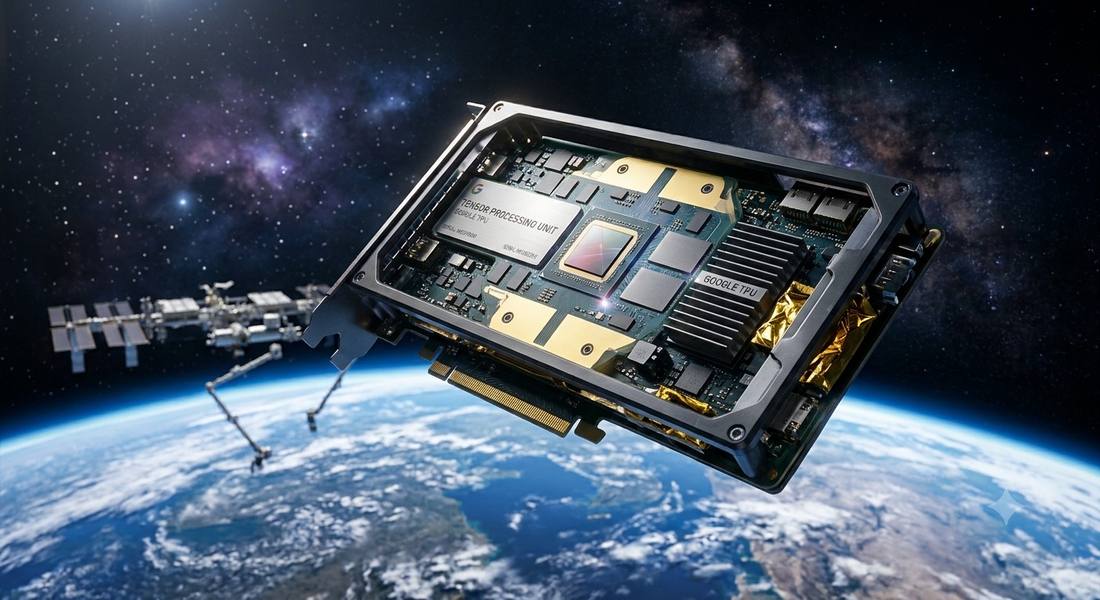
On October 30, 2026, Google confirmed its Project Suncatcher prototype satellite started a TPU in orbit, with Gemma 4 writing a space haiku and returning it to the ground. The satellite launched on October 1 aboard SpaceX's Transporter-18.
- 01THE LAUNCH — October 1, 2026: the prototype satellite launches aboard Transporter-18.
- 02THE UPLINK — As the ground station passes, the prompt is uplinked to the on-board Gemma 4.
- 03THE INFERENCE — The on-board TPU starts, completes inference and writes a space haiku.
WHAT HAPPENEDWhat Happened
On October 30, 2026, Google chief executive Sundar Pichai announced that a Project Suncatcher prototype satellite had completed a full round-trip request from the ground to orbit and back. The team sent a command to orbit, started the on-board TPU, ran a prompt and received a complete answer: a haiku.
The haiku described a view of space from the satellite's perspective. The prompt was uplinked as the satellite passed a ground station, and the answer was downlinked as it passed over Svalbard, Norway. The team then tried space-themed limericks, and prompts asking the satellite to report on payload status.
The satellite launched on October 1 aboard SpaceX's Transporter-18 rideshare mission, built by Google in partnership with Planet, carrying four Trillium-generation TPUs. Subsystem checkout was completed in the roughly three weeks before launch, and only then did the first prompt go up.
HELLO WORLDOne Haiku Validates an Entire Chain
The haiku itself is worthless; the chain is what matters. Uplinked command, on-board start-up, model inference, downlinked return: if any link broke, the haiku would never have come back. Google calls this milestone Suncatcher's hello world, meaning proof the chain works first, scale later.
The model is a Gemma 4 pre-loaded on the satellite, running inference, not training. Inference needs far less compute, which is why orbital computing starts with inference. The first job is keeping the chip alive in orbit; only then does the size of its workload matter.
ORBITAL LIMITSThe Constraints in Orbit Are Nothing Like Those on the Ground
Ground data centres are short of power and cooling; in orbit both are more extreme. Satellite power generation tops out at about 1 kilowatt, and in a vacuum there is no air to carry heat away, so the TPU's heat concentration is the hardest part to dissipate. A single run window of about 20 minutes is itself the thermal constraint written into the operations manual.
Radiation is another hurdle. Particles can flip bits in memory, silently corrupting data. Google's ground-based proton-beam tests show high-bandwidth memory is the most sensitive under accumulated dose, though the estimated impact on inference workloads is within acceptable range; the in-orbit test exists to verify that estimate.
THE 2030S BETThe Real Target Is the 2030s
Suncatcher's long-term vision is a solar-powered satellite constellation, each satellite carrying TPUs and linked by free-space optical communications, moving AI workloads into orbit. The two satellites planned for 2027 focus on validating higher power generation and inter-satellite optical links.
Competitors have moved first. Starcloud sent an Nvidia H100 into orbit last year and ran training on it; what Google has caught up on this time is in-orbit inference with a data-centre-grade TPU. Whoever runs a constellation reliably first earns the right to do the cost maths on orbital compute.
THE SHIFTWhat Changed
SIGNAL JUDGMENT — ANALYSISOrbital Compute Must First Prove It Can Survive
Tokenta Signal's judgment: the weight of one haiku lies not in the poem, but in the chain. The threshold for orbital computing was never whether the model runs; it is whether the chip can live for a long time amid radiation and heat.
WHAT REMAINS UNCERTAINWhat Remains Uncertain
EVIDENCEEvidence
The original report confirms Google's Project Suncatcher prototype satellite completed in-orbit TPU inference on October 30, 2026, with Gemma 4 writing a space haiku and returning it to the ground; the satellite launched on October 1 aboard SpaceX's Transporter-18.
PRIMARY SOURCESPrimary Sources
- OfficeChai: Google Successfully Runs Inference From A TPU In Space Under Project Suncatcher
https://officechai.com/ai/google-successfully-runs-inference-from-a-tpu-in-space-under-project-suncatcher/ - AI Affairs: Google's Project Suncatcher satellite returns an AI response from orbit
https://www.aiaffairs.com/technology/google-project-suncatcher-satellite-ai-response-orbit/
RELATEDRelated Intelligence
- Microsoft Winds Down Its Oracle AI Cloud Rental as Older Nvidia Chips Fall Behind
- An Unreleased Anthropic Model Proved an 18-Year-Old Quantum Conjecture, Machine-Checked in Lean
- IBM Unveils Quantum System Two in Chicago, Its Most Advanced Computer Yet, Powered by Nighthawk
- Vistra Posts $1.14B Q3 Profit as Power EBITDA Jumps Over 50%, Lifts 2026 Outlook