
Claude Rewrote Its Own API, Moving It From Python to Rust
Anthropic engineers revealed on an October 27 podcast that the Claude Messages API has fully moved from a Python monolith to a Rust version written by Claude itself, saving an estimated 40% to 50% of CPU and cutting time to first token by 10% to 20%.
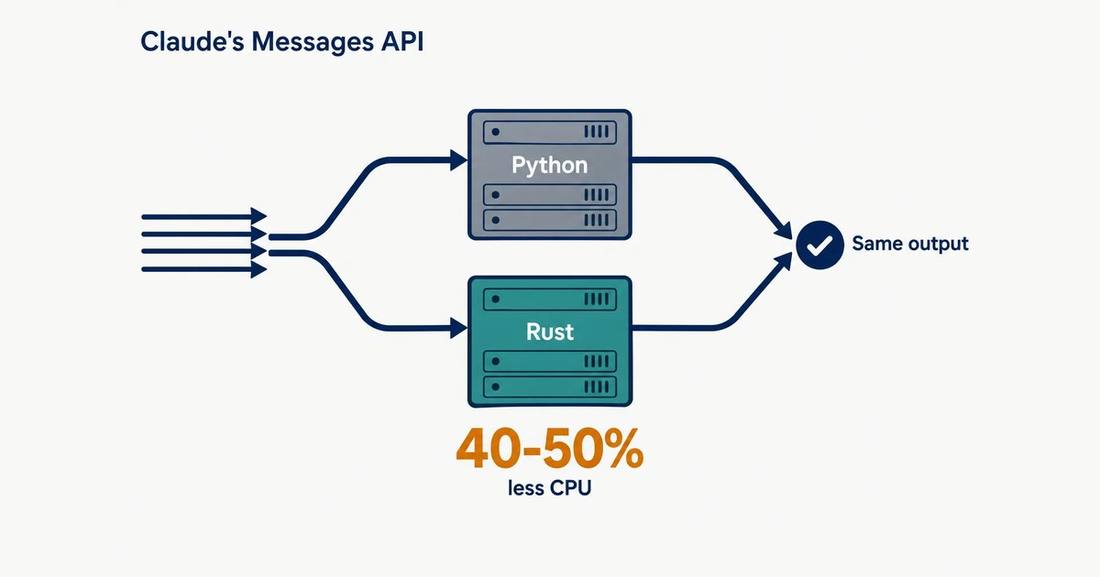
- 01THE MONOLITH — The Messages API was a Python monolith running in a single cloud region.
- 02THE SPLIT — Humans designed the system architecture; Claude wrote the Rust code.
- 03THE SHADOW — A complete Rust branch ran shadow traffic, compared item by item against Python.
WHAT HAPPENEDWhat Happened
Anthropic engineers revealed on the October 27 episode of the Latent Space podcast that the Claude Messages API has fully switched to a Rust version. The original Python monolith ran in a single Google Cloud region and was highly CPU-inefficient; the team concluded it would eventually hit a CPU ceiling.
When Rust was chosen, the team had almost no Rust programmers. Humans designed the distributed system architecture; Claude wrote the code. The team first built a complete Rust branch and compared its output item by item against the Python system using shadow traffic, switching live traffic only after the outputs matched.
The result was a pure port, with no new features. The engineers' estimates: CPU savings of 40% to 50%, and time to first token 10% to 20% faster. Those figures come from oral answers on a podcast, not a formal benchmark report, and should be read as estimates.
FIXED BUDGETCPU Is a Fixed Budget, Not an Infinite Resource
The engineers put it plainly: CPU is a fixed budget negotiated with the cloud provider, to be divided among product serving, agent sandboxes, continuous integration and research. The more code agents write, the more CI runs there are, and the wider the CPU gap grows.
Making each request cheaper is more direct than buying more CPU. Rust was not chosen to chase a fashionable language, but to run more requests within a fixed budget. Here, language choice is a cost question, not a taste question.
SHADOW TRAFFICShadow Traffic Was the Real Guardrail of This Port
A team with no Rust programmers dared to rewrite a core API because of its verification method. A complete branch plus shadow-traffic comparison amounts to making the new system sit a shadow exam on real traffic first: wrong answers do not affect users, and only matching results get through.
That methodology is worth more than the language itself. The larger the scale of agent-written code, the heavier verification weighs. Writing code can be delegated to a model; judging whether the old and new systems are equivalent requires a comparison mechanism that does not depend on the model.
SAME ROADGitHub Is on the Same Road
Anthropic is not alone. In September, GitHub published how the Copilot agent runtime migrated from TypeScript to Rust, likewise written under agent leadership, likewise with gains accounted down to the token bill. What the two companies share is treating agents as rewriting tools, not demo tools.
The difference is the completeness of the evidence. GitHub produced a verifiable bill; Anthropic so far has only podcast estimates. The agent-coding narrative is shifting from whether agents can write code to how much money the finished code saves, and the standard of evidence is rising with it.
THE SHIFTWhat Changed
SIGNAL JUDGMENT — ANALYSISAgents Write the Code; Verification Is the Real Engineering
Tokenta Signal's judgment: the highlight of this port is not that Claude can write Rust. It is that a team with no Rust programmers dared to accept delivery via shadow traffic. The bottleneck of agent coding is shifting from writing code to verifying it.
WHAT REMAINS UNCERTAINWhat Remains Uncertain
EVIDENCEEvidence
The original confirms that Anthropic engineers revealed on an October 27 podcast that the Claude Messages API has fully moved from a Python monolith to a Rust version written by Claude itself, saving roughly 40% to 50% of CPU and cutting time to first token by 10% to 20%.
PRIMARY SOURCESPrimary Sources
- CellCog: Anthropic Rewrote Claude's Messages API in Rust
https://cellcog.ai/blog/anthropic-messages-api-rust-rewrite/ - Sputnik Intelligence: Angela Jiang on the Messages API Rust rewrite
https://sputnikintelligence.com/things/quote/bkmr-pu6k-7zu6
RELATEDRelated Intelligence
- Microsoft Winds Down Its Oracle AI Cloud Rental as Older Nvidia Chips Fall Behind
- An Unreleased Anthropic Model Proved an 18-Year-Old Quantum Conjecture, Machine-Checked in Lean
- IBM Unveils Quantum System Two in Chicago, Its Most Advanced Computer Yet, Powered by Nighthawk
- Vistra Posts $1.14B Q3 Profit as Power EBITDA Jumps Over 50%, Lifts 2026 Outlook