
Nvidia and Cisco Open the Optical Aperture Four Times Wider
On October 12, Nvidia and Cisco announced the USFP programme at the OCP summit: an ultra-dense, small-form-factor pluggable optical module, the first pluggable form targeting 400Gb/s-per-lane Ethernet AI networking. The first modules pack 16 full-duplex lanes into an OSFP-size package, expandable in future to 32 lanes for a total capacity of 12.8Tb/s.
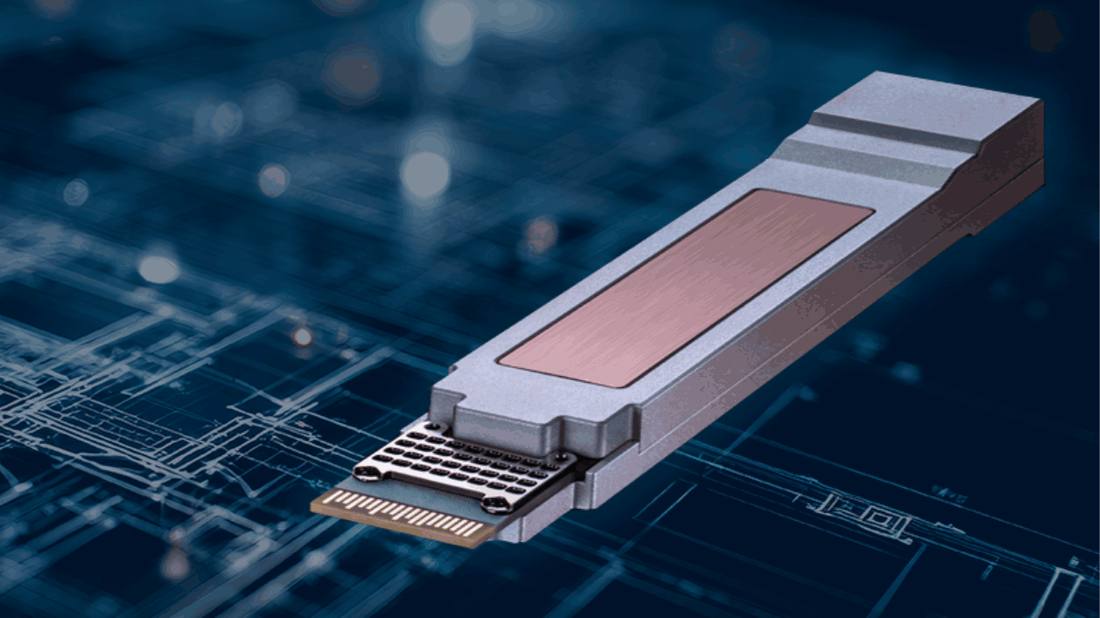
- 01THE ANNOUNCE — On October 12, Nvidia and Cisco announced the USFP programme at OCP, targeting next-generation AI factories.
- 02THE FORM — 16 full-duplex lanes packed into an OSFP-size package, supporting switches and SuperNICs.
- 03THE MATH — 400Gb/s per lane, 4x bandwidth density, 1.3x energy efficiency, expandable to 32 lanes in future.
WHAT HAPPENEDWhat Happened
USFP's arithmetic is direct: lane rates double from 200Gb/s to 400Gb/s, lane counts double in step, bandwidth density reaches four times that of existing modules and energy efficiency about 1.3 times. Without adding switch tiers, AI factories can attach more compute within the same network footprint, and the network's share of total power draw falls accordingly.
The ecosystem is written into the announcement as well: TE Connectivity and Amphenol are participating in connector and module development, with the goal of an open, multi-source specification. USFP is currently a programme and form-factor announcement, not a volume-shipment announcement; the delivery schedule awaits later disclosure.
THE BOTTLENECK MOVESThe bottleneck moves from the chip to the panel
The expansion logic of AI factories is shifting gears: compute can be stacked with more cards, but the network must pass through the panel. Once switch ports run out, every added switching tier adds latency, power draw and cost.
USFP's answer is no new tiers, only more density: more lanes on the same panel, each running faster. Network upgrades degenerate from architecture changes into module swaps, flattening the deployment cost curve a notch.
THE PLUGGABLE BETPluggable: a position on co-packaged optics
USFP's insistence on the pluggable route amounts to a reservation vote against co-packaged optics: modules can be swapped, repaired and multi-sourced, without soldering the optics to the switch silicon.
For buyers that is tangible benefit: a multi-source specification means no lock-in to a single supplier, and failed modules can be replaced individually. The cost is a density ceiling below co-packaged solutions, leaving the long-term route unsettled.
THE POWER MATH1.3x energy efficiency — the bill must be counted per rack
1.3 times the energy efficiency sounds modest; at AI-factory scale it is another matter: the network's share of power falls, and the saved electricity can be left for compute.
But vendor efficiency figures are module-level comparisons, not whole-rack measurements. The energy savings that actually land must await operators' power bills, not launch-event multiples.
THE SHIFTWhat Changed
SIGNAL JUDGMENT — ANALYSISBigger apertures make the accounting work
USFP's significance is not the number 400, but that it moves AI infrastructure competition from chip compute to panel density at the rack door. Tokenta Signal's judgment stands: the next stop of the compute race is the interconnect race — whoever works out port density and the power bill first takes the next generation of AI factory orders.
WHAT REMAINS UNCERTAINWhat Remains Uncertain
EVIDENCEEvidence
The official original confirms all core figures: 400Gb/s per lane, 4x bandwidth density, 1.3x energy efficiency, 16 lanes in an OSFP-size package, expansion to 32 lanes and 12.8Tb/s, with TE Connectivity and Amphenol participating in the ecosystem.
PRIMARY SOURCESPrimary Sources
- Cisco official newsroom: NVIDIA and Cisco Introduce New Pluggable Optics Form Factor
https://newsroom.cisco.com/c/r/newsroom/en/us/a/y2026/m10/nvidia-and-cisco-new-pluggable-optics-to-scale-ai-factories.html - HPCwire: NVIDIA and Cisco Introduce New Pluggable Optics Form Factor
https://www.hpcwire.com/off-the-wire/nvidia-and-cisco-introduce-new-pluggable-optics-form-factor-to-scale-ai-factories/ - Futurum: Cisco USFP Advances NVIDIA's Optical Roadmap
https://futurumgroup.com/insights/ciscos-usfp-brings-400g-per-lane-design-to-nvidias-optical-roadmap/
RELATEDRelated Intelligence
- Microsoft Winds Down Its Oracle AI Cloud Rental as Older Nvidia Chips Fall Behind
- An Unreleased Anthropic Model Proved an 18-Year-Old Quantum Conjecture, Machine-Checked in Lean
- IBM Unveils Quantum System Two in Chicago, Its Most Advanced Computer Yet, Powered by Nighthawk
- Vistra Posts $1.14B Q3 Profit as Power EBITDA Jumps Over 50%, Lifts 2026 Outlook