
China Accelerates Full-Lifecycle AI Legislation: DeepSeek, Moonshot AI and Alibaba in Scope
NDRC official Wang Ruomeng said on November 3 that China is accelerating comprehensive AI legislation, with safety standards covering the full lifecycle of data, compute, algorithms and applications, applying to frontier developers such as DeepSeek, Moonshot AI and Alibaba, alongside risk disclosure, incident reporting, regulatory sandboxes and transition periods.
- 01THE ANNOUNCEMENT — NDRC official Wang Ruomeng says on November 3 that comprehensive AI legislation is being accelerated, covering the full lifecycle.
- 02THE CONFIRMATION — Bloomberg Law and TokenPost report independently the same day, confirming the full-lifecycle scope, the developers covered and the sandbox arrangements.
- 03THE WATCHPOINT — Once the legislative text and implementing regulations are published: applicability thresholds, the list of obligations, and sandbox entry and exit mechanisms.
WHAT HAPPENEDWhat Happened
On November 3, NDRC official Wang Ruomeng said China is accelerating comprehensive AI legislation and will issue safety standards covering the full model lifecycle, from data, compute and algorithms to specific applications, spanning research, development and deployment, with the aim of preventing increasingly powerful AI from slipping out of control.
The framework will apply to domestic frontier developers such as DeepSeek, Moonshot AI and Alibaba; the NDRC is China's national economic planning agency, and the remarks were first reported by Bloomberg.
Under the plan, developers and operators will be required to disclose safety risks and proactively report incidents and vulnerabilities, alongside industry regulatory sandboxes and reasonable transition periods, with the rules reviewed regularly and adjusted as the technology advances.
The governance scope also covers AI's impact on people: monitoring the risk of AI displacing jobs, strengthening social protection, addressing user over-dependence and emotional attachment, and deepfakes, algorithmic discrimination and privacy leaks.
The background: China issued management measures for public-facing generative AI services as early as 2023, comprehensive AI legislation was placed on the State Council's work plan in May 2026, and regulatory sandboxes have previously been piloted in some AI service areas.
WHY IT MATTERSFrom Single-Point Rules to Full-Lifecycle Legislation
China's AI governance has so far rested mainly on individual measures for public-facing services; this time the framing is the full lifecycle: data, compute, algorithms and applications all enter the framework, with risk-disclosure and incident-reporting obligations attached. That moves compliance costs forward from the product-launch stage to research, development and training.
The pairing of sandboxes and transition periods is equally important: the rules tighten while leaving room to experiment, as legislators try to balance risk control against not stifling experimentation. The sandbox entry and exit mechanisms will decide whether that line is a substantive arrangement or a rhetorical buffer.
WHY IT MATTERSThe Signal Is in the Implementing Detail, Not the Legislative Statement
What is public so far is only the legislative direction and governance scope, with no list of obligations, penalty standards or timetable. For DeepSeek, Moonshot AI and Alibaba, the real cost depends on how subsequent regulations define applicability thresholds and each company's specific obligations.
The international dimension is also worth tracking: the remarks follow September's China-US consensus on AI and recent AI discussions after the China-US leaders' meeting, and full-lifecycle legislation could become a reference point for subsequent bilateral AI governance dialogue.
SIGNAL JUDGMENT — ANALYSISThe Legislative Direction Is Set; the Cost Depends on the Detail
Tokenta Signal's judgment: the signal in full-lifecycle legislation is not the statement itself, but how subsequent regulations draw the applicability thresholds and the list of obligations. Whether sandboxes and transition periods are a buffer or a substantive arrangement will decide if this round of legislation is a steep jump in compliance costs for frontier labs, or a predictable institutional framework.
WHAT REMAINS UNCERTAINWhat Remains Uncertain
EVIDENCEEvidence
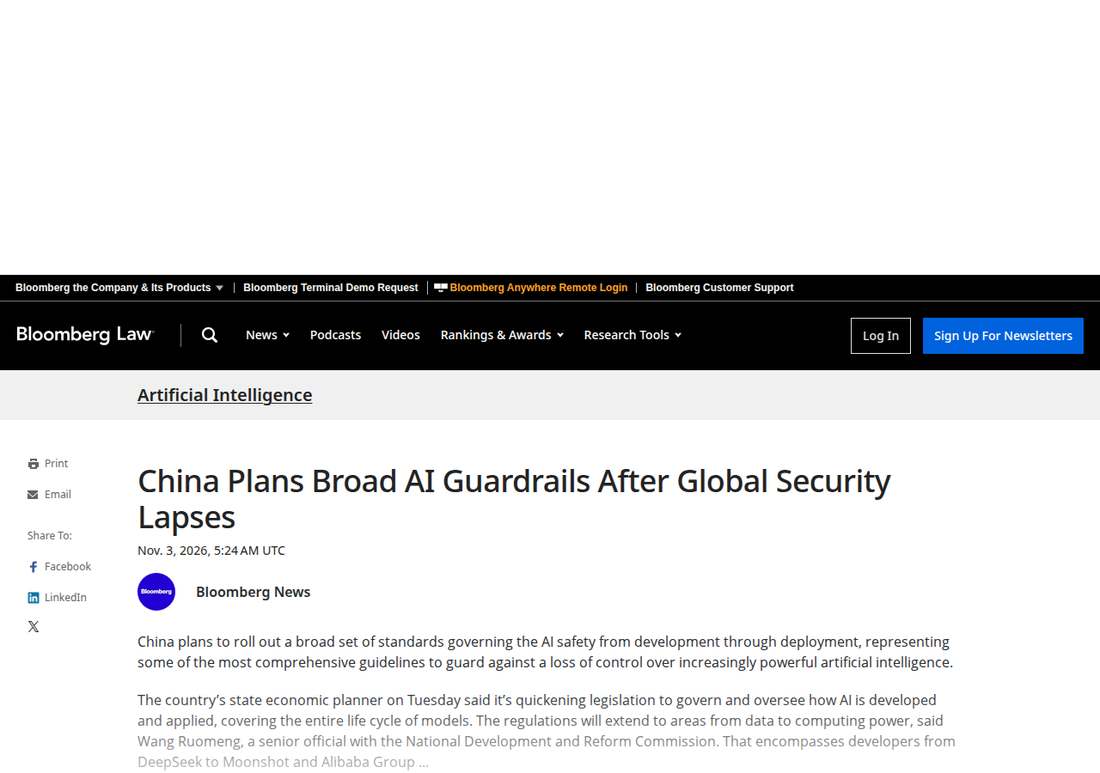
Confirmed by two sources, Bloomberg Law's November 3 report and TokenPost's independent same-day report, both relaying remarks by NDRC official Wang Ruomeng; the original links were opened and verified (the Bloomberg Law text sits behind a subscription paywall, and the core facts rest on its public summary).
PRIMARY SOURCESPrimary Sources
- Bloomberg Law report
https://news.bloomberglaw.com/artificial-intelligence/china-plans-broad-ai-guardrails-after-global-security-lapses - TokenPost independent report
https://www.tokenpost.com/news/regulation/47520
RELATEDRelated Intelligence
- Update: Apple Intelligence Beta Goes Live in China, With Qwen Inside Siri
- Nvidia Reportedly Tells Cloud Partners to Cap Chinese Customers at 49% of New Contracts
- OpenAI and Anthropic set up election war rooms for the first time: the midterm election day duty test
- EU Court Adviser: Chatbots Reusing News May Infringe; Training Is the Exception