
A 3-Trillion-Parameter Chinese Model, Fitted onto 59 American Wafers
Cerebras did the maths with Kimi K3: 3 trillion parameters, 93 layers, 59 wafers, 1,000 to 2,000+ tokens per second. The arithmetic is elegant, but the official blog never says this system actually ran — it offers a deployment recipe, not a measurement report.
- 01THE POST — On October 22, Cerebras published its official technical blog, with Kimi K3 as the star of the deployment calculation.
- 02THE MATH — 4-bit quantisation, 16GB per layer, 44GB of on-chip memory — the 59-wafer bill is settled on the spot.
- 03THE CLAIM — Pipeline parallelism with weights never leaving the chip claims 1,000 to 2,000+ tokens per second for multi-trillion-parameter models.
WHAT HAPPENEDWhat Happened
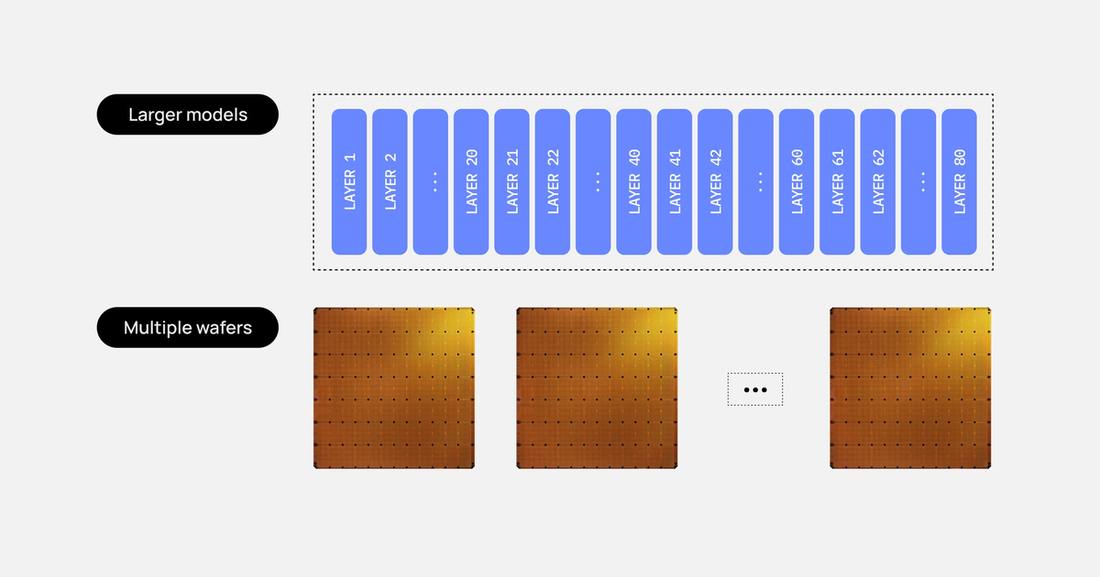
On October 22, Cerebras published a technical blog post, 'How we deploy trillion-parameter frontier models on Cerebras', using Moonshot AI's open-source Kimi K3 as the example. Kimi K3 has roughly 3 trillion parameters across 93 layers: 69 linear-attention layers and 24 full-attention layers. Each WSE-3T wafer carries 44GB of on-chip SRAM; with weights quantised to 4 bits, each layer takes about 16GB.
The arithmetic is simple: full-attention layers must reserve space for the KV cache, so one layer occupies one wafer — 24 layers take 24 wafers. Linear-attention layers keep only a fixed-size state, so two can share a wafer — 69 layers take 35 wafers. Twenty-four plus thirty-five is exactly 59 wafers. The weights live permanently on-chip and never move; only activations travel between wafers, over RDMA Ethernet at about 2 microseconds per hop. Cerebras says multi-trillion-parameter models on this pipeline can produce 1,000 to 2,000+ tokens per second.
THE FINE PRINTFour words hidden in the original: illustrative example
Cerebras states at the outset that Kimi K3 is an 'illustrative example'. The entire post is a derivation of a deployment recipe: assume a 256k average request length, 4-bit weights, 8-bit KV cache, then work through memory, wafer count and concurrency step by step. It proves 'it fits' — not 'it ran'.
Independent tech outlet dailyinference was more direct: Cerebras did not say whether this Kimi K3 layout has actually run, and provided no independently verified results, complete benchmark conditions or measured power consumption matching the claimed speeds. Between the marketing narrative and engineering measurement lies a whole blog post of assumptions.
THE ARCHITECTURE BETFitting 3 trillion parameters relies on the model slimming down first
The premise that makes this maths work is Kimi K3's hybrid architecture: 69 of its 93 layers are linear attention, holding only a fixed-size state with no KV cache that swells with context. Swap in a full-attention model, where every layer must reserve KV-cache space on the wafer, and the number 59 collapses immediately.
In other words, Cerebras' wafer narrative and Moonshot AI's architecture choices complete each other: the model makes attention 'light' first, and only then dares the hardware to lock all weights on-chip. Half of the 2026 inference race is about chips; the other half is about whose model best saves the hardware room.
THE SIGNALA Chinese model on an American chip's demonstration stage
One detail is easily skipped: the model Cerebras used to showcase its flagship hardware is not a closed model from a US lab, but an open-weight model from a Chinese team. Kimi K3.1 Pro landed on October 24, and the Kimi family has already become one of the default demonstration subjects for inference infrastructure worldwide.
The script has reversed completely. It used to be Chinese vendors testing their cards on American models; now it is an American vendor showing off its wafers with a Chinese model. The speed at which open weights spread is rewriting the order of who endorses whom.
THE SHIFTWhat Changed
SIGNAL JUDGMENT — ANALYSISThe prettier the maths, the harder to ask: did it run?
The value of Cerebras' post is not the number 59; it is that it lays the inference-infrastructure contest out as a maths problem anyone can recompute. But Tokenta Signal's judgment stands: an illustrative calculation proves possibility; measured data proves capability. Until the power numbers arrive, fitting 3 trillion parameters onto 59 wafers is the first half, not the final whistle.
WHAT REMAINS UNCERTAINWhat Remains Uncertain
EVIDENCEEvidence
The key qualifications in the official original are all between the lines: Kimi K3 is explicitly called an 'illustrative example'; the 1,000-2,000+ tokens per second is a generic figure for multi-trillion-parameter models, and the original gives no measured throughput or power consumption for this 59-wafer layout.
PRIMARY SOURCESPrimary Sources
- Cerebras official blog: How Cerebras Deploys Trillion-Parameter AI Models
https://www.cerebras.ai/blog/how-we-deploy-trillion-parameter-frontier-models-on-cerebras - dailyinference: 59 Wafers to Hold One Trillion-Parameter Model
https://dailyinference.news/articles/2026-10-25-59-wafers-to-hold-one-trillion-parameter-model-cerebrass-math-says/ - ai0.news daily AI briefing (2026-10-25): Cerebras Spans 59 Wafers for 3T Kimi
https://ai0.news/posts/2026-10-25-daily-digest/
RELATEDRelated Intelligence
- Microsoft Winds Down Its Oracle AI Cloud Rental as Older Nvidia Chips Fall Behind
- An Unreleased Anthropic Model Proved an 18-Year-Old Quantum Conjecture, Machine-Checked in Lean
- IBM Unveils Quantum System Two in Chicago, Its Most Advanced Computer Yet, Powered by Nighthawk
- Vistra Posts $1.14B Q3 Profit as Power EBITDA Jumps Over 50%, Lifts 2026 Outlook